


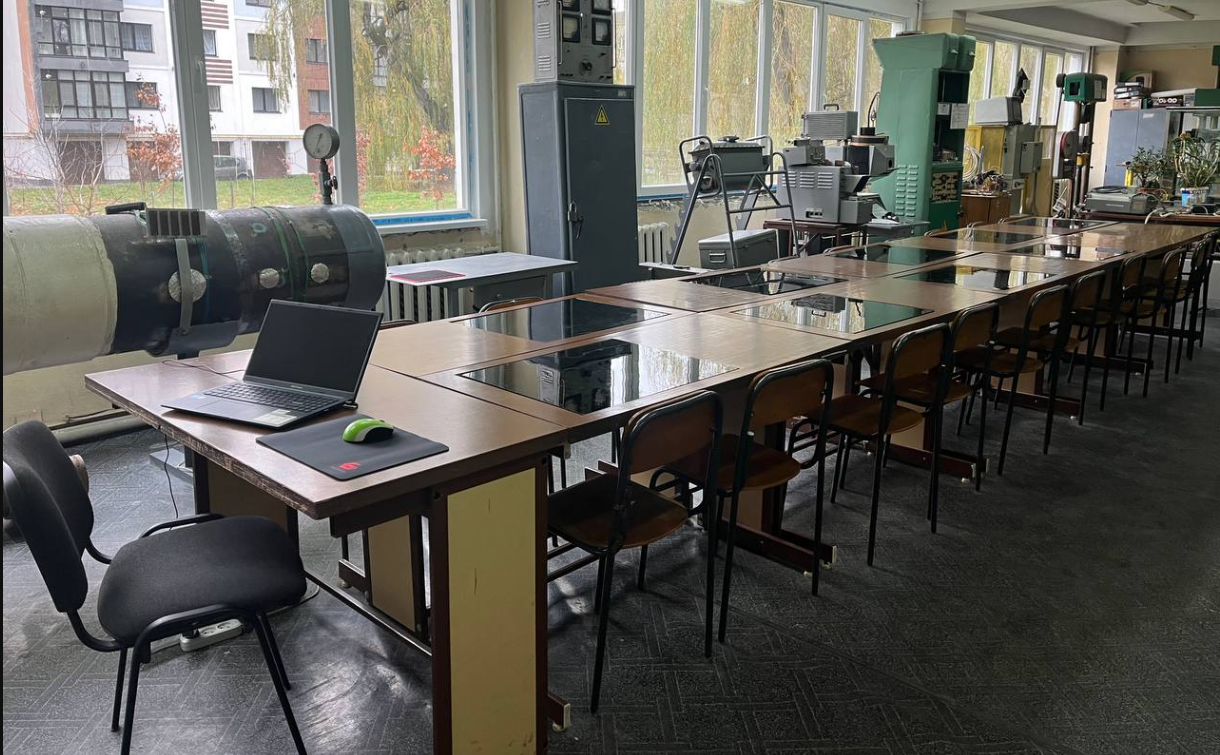
Educational and Research Laboratory of Pipe Welding named after Professor Yu. H. Hagen is one of the key practical units of Ivano-Frankivsk National Technical University of Oil and Gas. The laboratory is located in room 0112 with a total area of 149.3 m² and combines two functional sectors: educational and research. Named in honor of the prominent scientist in the field of welding and strength of pipeline structures, the laboratory preserves the traditions of the department’s scientific school while also being a modern platform for training welding engineers and researchers.
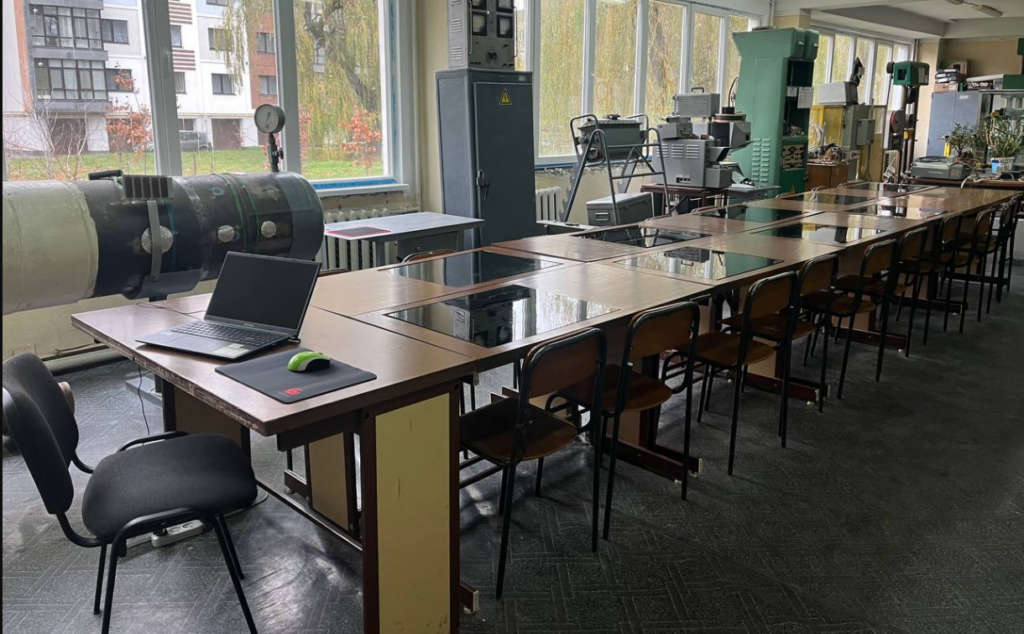
Educational Sector
The educational sector is equipped with appropriate furniture, visual aids, and a multimedia projector. Here, lectures, laboratory, and practical classes are conducted on subjects related to pipeline welding technology and the quality control of welded joints.
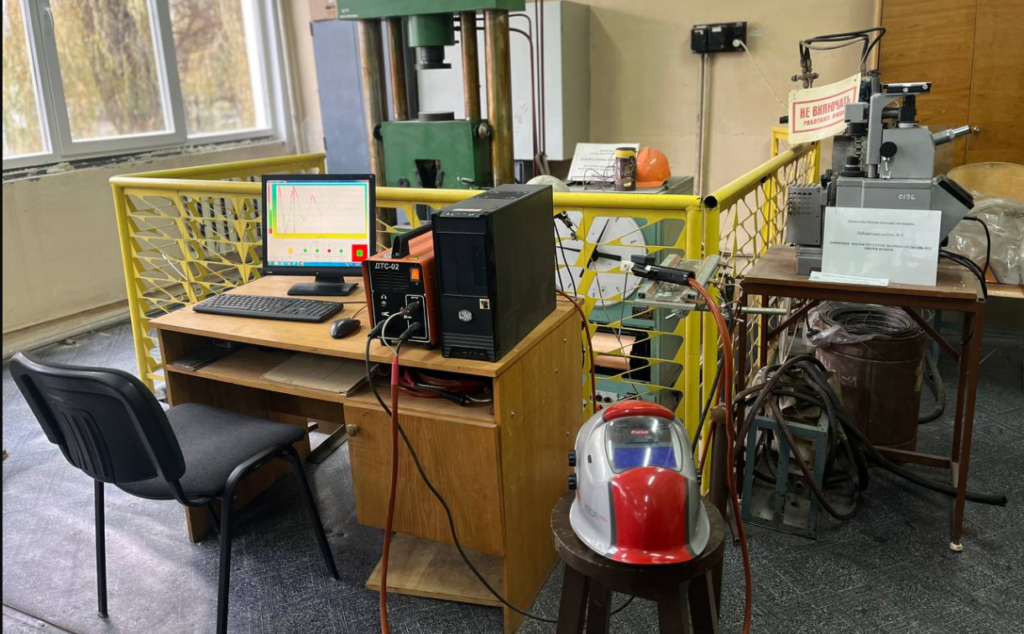
Arc Welder Simulator DTS-02 using a personal computer allows students to practice arc welding skills in a safe simulation environment before moving on to work with real equipment. The simulator tracks the electrode movements, angle of inclination, and welding speed, providing instant feedback.
Installation for Submerged Arc Welding GDF-1000 with power source VDU-1000 designed for the practice of automated welding processes — a technology widely used in the manufacture and repair of main pipelines. The high power of the system allows for welding of significant metal thickness under conditions close to industrial.
Hardness Tester TDM-1 used to determine the hardness of the metal in the weld seam and the heat-affected zone — one of the key quality indicators of a welded joint and its compliance with regulatory requirements.
Gas burner and cutter provide practical mastery of gas welding and thermal cutting technologies for metals — basic processes in the installation and repair of pipeline systems.
Pipe Cutting Machine “Orbita-1” designed for orbital tube cutting — preparing ends for welding. The orbital method ensures a strictly perpendicular even cut, which is a mandatory condition for a high-quality butt weld on pipelines.
For the study of the macrostructure and defects of welded joints in the educational process, a collection of samples of welded joints is used,, showing different types of seams, characteristic defects, and their impact on the strength of the structure.
Research Sector
The research sector of the laboratory is equipped with equipment for mechanical testing and determining the stress-strain state of pipeline structures — including those with repair overlays and composite reinforcements.
Testing Machine R-50 designed for testing materials and welded joints for compression, bending, and shear with a maximum load of up to 50 kN. Used for evaluating the mechanical properties of welds and repair structures of pipelines.
Testing tensile machine UMM-5 used to determine the tensile strength of metal samples, welded joints, and composite materials. The obtained characteristics—ultimate strength, yield strength, and relative elongation—are the initial data for calculating the reliability of pipeline structures.
Spider-8 Stress Recorder — multi-channel measurement system for simultaneous recording of deformations and stresses at several points of a structure under load. Used in strain gauge studies of the stress-strain state of pipes, welded joints, and repair structures under static and dynamic loading conditions.
Portable Thickness Gauge allows measuring the remaining wall thickness of a pipe using the ultrasonic method without destroying the sample. It is used to assess the degree of corrosion wear and the suitability of the pipeline for further operation.
Testing machine for cyclic loading designed for studying the durability of welded joints and pipeline structures under alternating loads. Cyclic fatigue is one of the main causes of pipeline failure due to pressure pulsations.
Test stand for stress-strain state of a pipe with a repair structure allows modeling the real working conditions of repair couplings and patches on pipeline sections with defects. The research results justify technical decisions regarding the choice of repair method and the load-bearing capacity of the repaired structure.
Stand for Testing the Stress-Strain State of a Pipe with Composite Bandage provides the study of the effectiveness of reinforcing defective sections of pipelines by applying composite wraps — a modern technology that allows for the repair of pipelines without interrupting the transportation of the product.
Scientific Activity
In the laboratory, research work is conducted on the assessment of the residual life of pipeline structures, development and verification of methods for repairing defective pipeline sections, and studying the strength of welded joints under complex loading conditions. The combination of educational and research sectors in one space ensures the involvement of students and postgraduates in real scientific projects during the learning process.