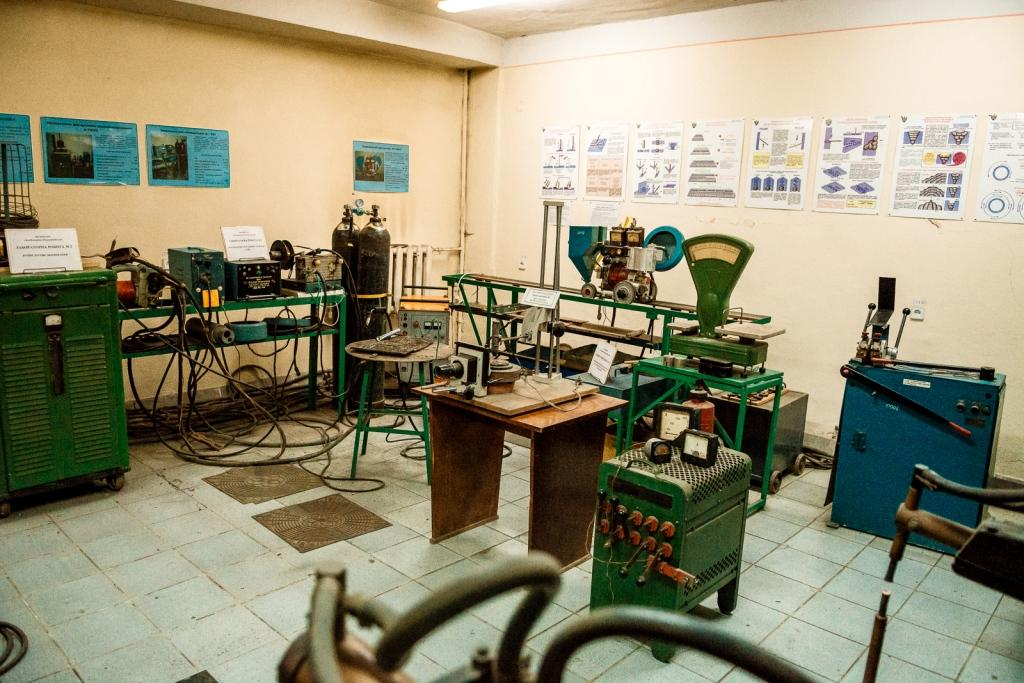
The Welding Training Laboratory is located in room 0114 of the Ivano-Frankivsk National Technical University of Oil and Gas, with a total area of 67.6 m², and serves as a fundamental practical platform for students training in welding technologies. The laboratory is divided into two functional sectors: fusion and pressure welding sector, and plastics welding sector. This layout reflects the real structure of welding technologies used in the construction and repair of oil and gas pipelines and industrial facilities.
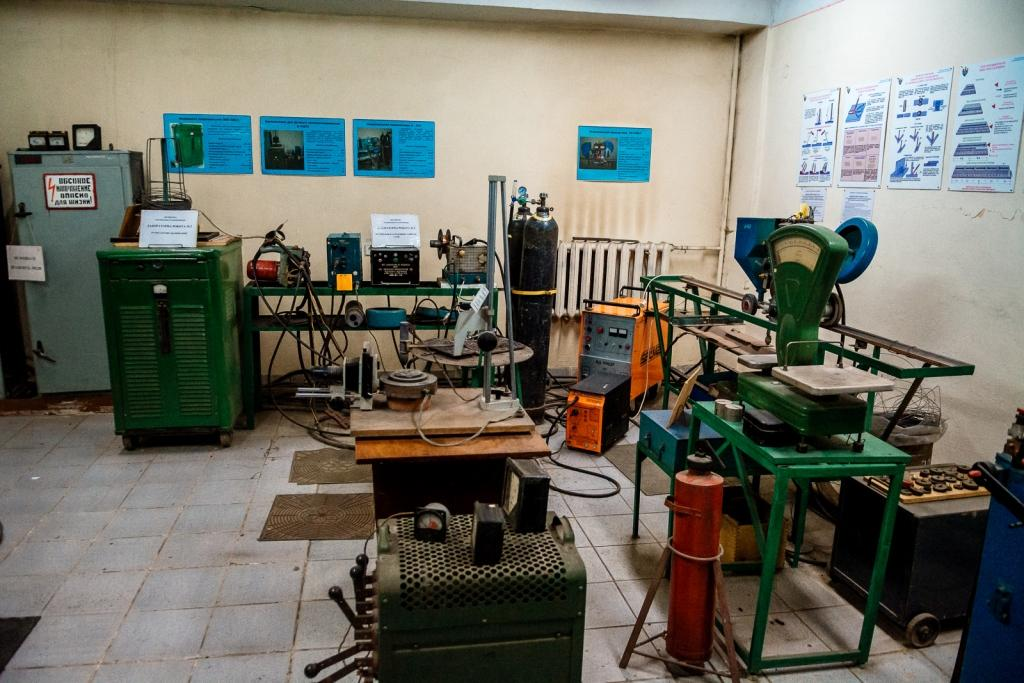
Section of Welding by Fusion and Pressure
Manual arc welding workstation OKS-1 is the main workplace for mastering basic skills in manual arc welding with a coated electrode — the most common welding method in the field for the installation and repair of pipelines.
Welding Rectifier VD-300 is a classic direct current source for manual arc welding. It ensures stable arc burning and is used for welding carbon and low-alloy steels, from which most industrial pipelines are made.
‘Ballast Rheostat RB-5 is used for smooth regulation of welding current and balancing the load between power sources during parallel operation. Allows students to explore the impact of welding mode parameters on the quality of the seam.
Welding inverter Fronius (Austria) — a modern inverter-type power source that provides precise digital control of welding parameters. It is used for manual arc welding, TIG, and MMA welding, replicating modes employed in modern industrial facilities.
MIG/MAG welding machine Forsag and MIG/MAG welding machine A-5477 designed for welding in shielding gases (MIG/MAG) — a method widely used in the manufacture of welded structures and repair of pipeline equipment. Semi-automatic welding combines high productivity with good seam quality.
Welding Tractor TS-17 — a device for automated welding under flux or in protective gases, moving along a rail path along the welded joint. The tractor demonstrates the principles of mechanized welding used in the production of pipeline sections and tanks.
Spot Welding Machine MT-600 and spot welding machine MT-1203 designed for spot contact welding of sheet metal structures. The method of contact welding is widely used in the production of thin-walled metal products and in the welding of reinforcement.
Contact Butt Welding Machine MS-500 used for butt welding by fusion and resistance — a technology applied for joining rods, small diameter pipes, and other profiled products. Ensures welding across the entire cross-section simultaneously without filler material.
Muffle furnace applied for annealing and heat treatment of welded joints — a technological operation that relieves residual welding stresses and improves plasticity in the heat-affected zone.
Soldering station provides practical training in soldering technologies — joining metals and non-metals using solder without melting the base material.
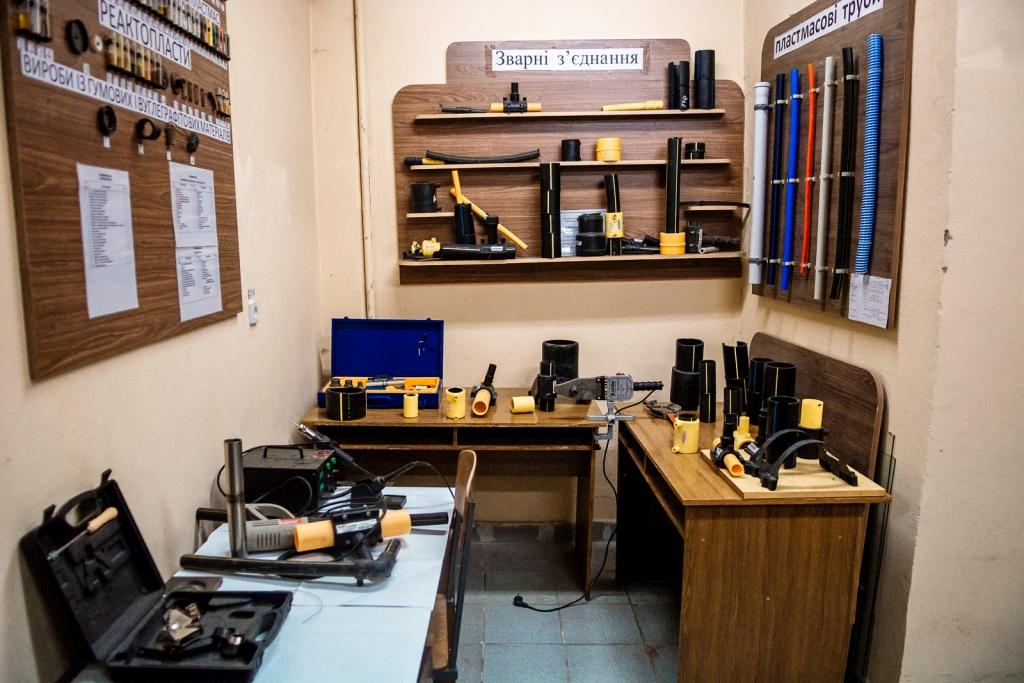
Plastic Welding Sector
Kadle polyethylene pipe welding kit designed for connecting polyethylene pipes using welding with embedded heater fittings. This technology is the standard for constructing low-pressure gas distribution networks from polyethylene pipes.
Butt Welding Machine for Polyethylene Pipes implements the method of butt welding with a heated tool — the most common technology for joining large-diameter polyethylene pipelines. On the installation, students practice the full cycle: end preparation, heating, upsetting, and quality control of the welded joint.
Heat gun used for welding and forming polymer materials with a stream of hot air. It is applied in the installation of small diameter plastic pipelines, repair of anti-corrosion coatings, and welding of sheet polymer structures.
Educational Process
The laboratory provides practical training in a wide range of welding technologies—from classic manual arc welding to modern methods of welding polymer pipelines. Students learn not only how to perform welded joints but also how to select the optimal welding method depending on the material, operating conditions of the structure, and regulatory requirements. Training in the laboratory develops competencies directly in demand for the construction, reconstruction, and repair of oil and gas pipelines and gas distribution networks.