


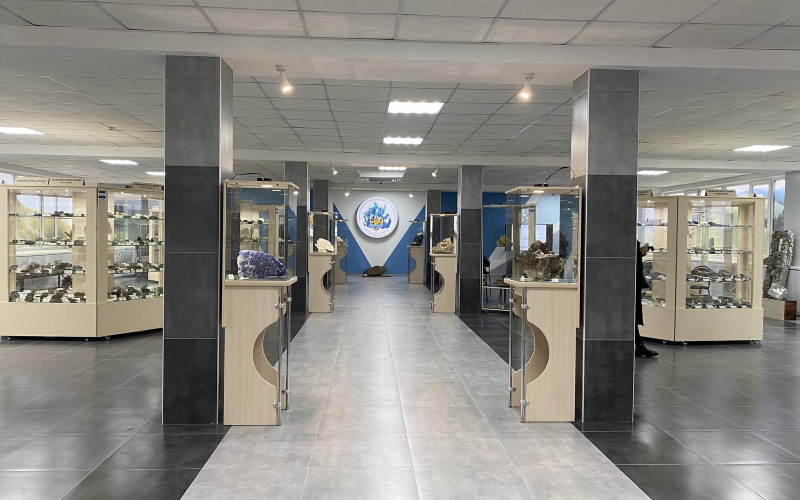
The Geological Museum of Ivano-Frankivsk National Technical University of Oil and Gas is one of the most outstanding natural history museums in Ukraine and Europe. In terms of the richness, diversity, and representation of its collections of minerals, rocks, mineral resources, and fossil remains of fauna and flora, it rivals the best university museums on the continent. The museum is located in the main building of the university in a hall with an area of 550 m² and is open to students, schoolchildren, scientists, and everyone interested in geology and natural science.
The Geological Museum of IFNTUOG has become one of the most popular locations for career orientation visits and campus tours for students, their parents, and teachers. A visit to the museum is a ready practical lesson that perfectly complements school courses in geography, natural sciences, and chemistry. A professional guide adapts the material to the age of the listeners — from light interesting stories for younger pupils to in-depth scientific facts for high school students.
The museum is open for visits and invites lyceum students and representatives of educational institutions. Tours for organized groups (lyceums, colleges) are usually conducted by prior arrangement to coordinate the time with the educational schedule.
Over 150 years of history
The establishment of the museum dates back to 1873 — the collections began to be gathered at the Technical Academy in Lviv. The founder was the eminent geologist of the Carpathian region. Julian Medvetsky (1845–1918), an alumnus of the University of Vienna, who headed the Department of Mineralogy at the Lviv Polytechnic Academy and systematically developed a collection that soon became one of the best geological collections in Central Europe.
Exhibits were received from exhibitions, museums, scientific expeditions, and private collectors from Paris, Vienna, Prague, Bonn, Dresden, Strasbourg, Freiberg, New York, Philadelphia, and many other cities around the world. Before World War II, the museum held an honorable place among similar institutions in Europe. In 1963, along with the Oil Faculty of Lviv Polytechnic Institute, the museum moved to Ivano-Frankivsk, where it continues its activities to this day.
In 2007, the mineralogical collection of the museum received the highest state recognition: it was included in the resolution of the Cabinet of Ministers of Ukraine into the State Register of Scientific Objects Constituting National Heritage.
Museum Collections
The museum is organized into six systematic sections, each reflecting a distinct branch of geological science.
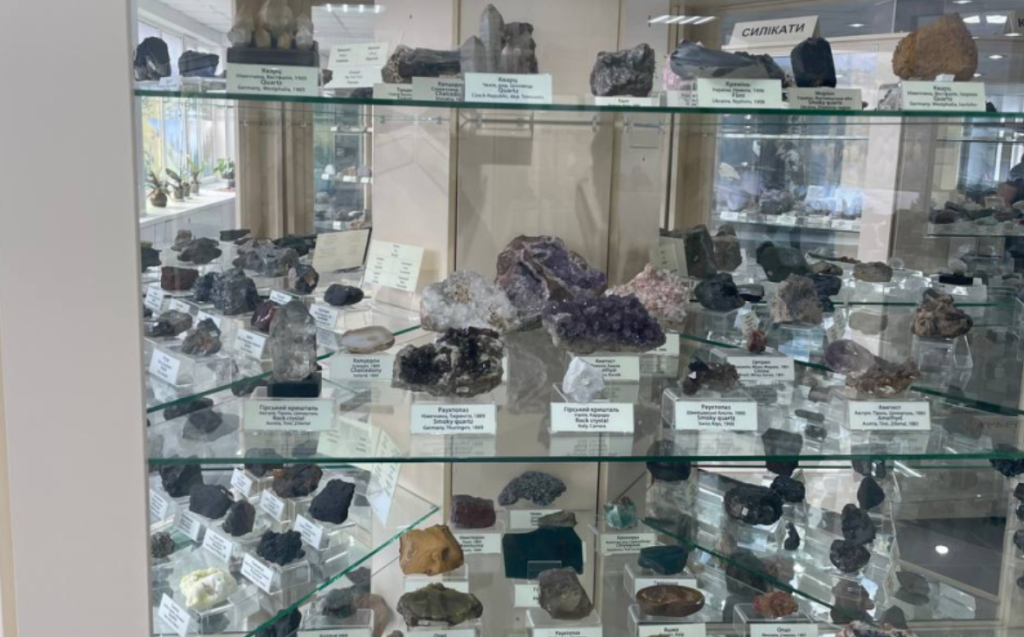
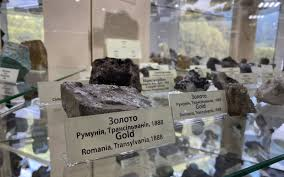
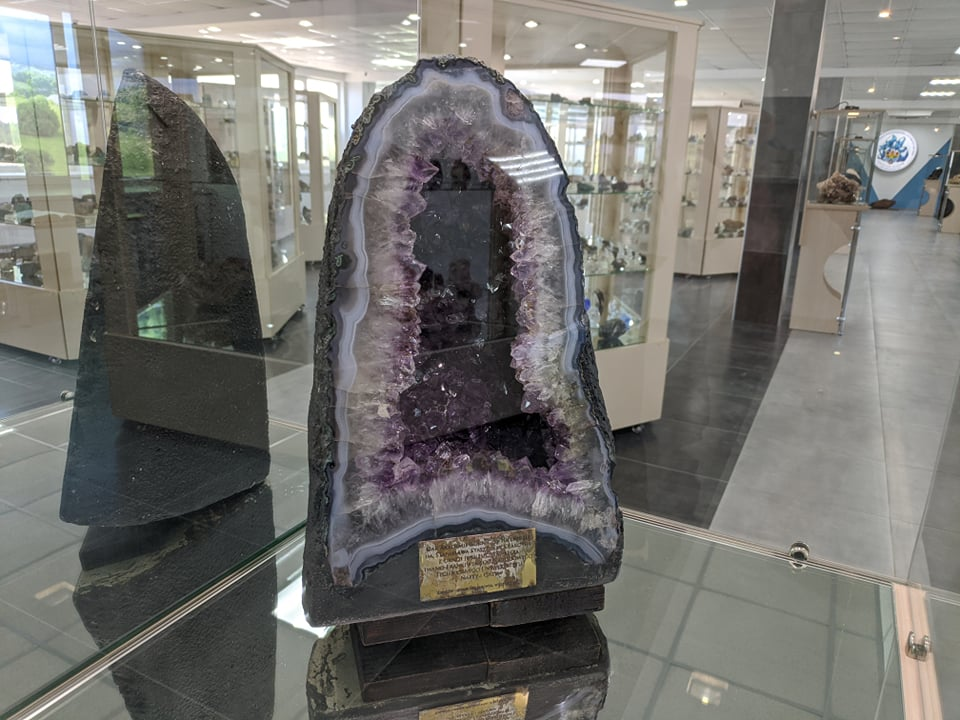
Mineralogy. The systematic and genetic collections of minerals from deposits around the world are displayed in 22 showcases. The minerals are selected according to the classification of academician E. Lazarenko based on chemical composition, crystalline lattice structure, and type of chemical bonds. The collections feature specimens of varied composition, color, and morphology — from faceted crystals to mineral aggregates of unusual forms. Among the particularly valuable specimens are opals from Australia, aragonite from Turkmenistan, and hundreds of other rare mineral species.
Petrography. Sixteen display cases represent all three genetic groups of rocks — igneous, sedimentary, and metamorphic — collected from many countries around the world. The collection illustrates the diversity of material composition and structure of rocks, which has direct practical significance in the search for minerals and the design of mining excavations.
Mineral resources. The section reveals the wealth of Ukraine’s subsoil: Donbas coal, granites, quartzites, labradorites, and topazes of Zhytomyr region, polymetallic ores of Zakarpattia, gypsum, sulfur, and ozokerite of Prykarpattia, salts of the Kalush potash deposit, oil from the fields of the Dnipro-Donets basin and Prykarpattia. A separate subsection is dedicated to the minerals of Ivano-Frankivsk region.
Historical Geology. The exposition in chronological order reveals the stages of development of the Earth’s crust and the changes in the organic world from the Archean era to the Cenozoic. The geochronological scale is illustrated with samples of rocks and fossil remains—characteristic representatives of each geological time period.
Paleontology. One of the most impressive sections of the museum. Here are displayed the simplest organisms, coelenterates, brachiopods, gastropods, cephalopods, and arthropods — from nummulites from Crimea to corals of various shapes and colors. The class of fish is illustrated by Jurassic period imprints found in Greenland, Lyon, and Bavaria. Predators are represented by bones, teeth, and the jaw of a cave bear. Among the most outstanding exhibits are mammoth tusks, a longitudinal section of nautilus, and imprints of insects and dragonflies.
Museum in the Life of the University and the City
The Geological Museum is a living part of the university, not just a repository of ancient collections. Educational activities are regularly conducted here with students of relevant specialties—petrography, mineralogy, and paleontology are better understood when you have a real specimen in front of you rather than an image in a textbook. Every year, the museum hosts hundreds of schoolchildren and lyceum students from Ivano-Frankivsk and the region, as well as delegations from Ukraine and abroad.
Scientific work is also being conducted: systematic electronic catalogs are being compiled for all exhibition departments, and unique collection specimens are the subject of scientific study, attracting researchers from various countries. The museum’s online representation is available at https://geomuseum.nung.edu.ua