


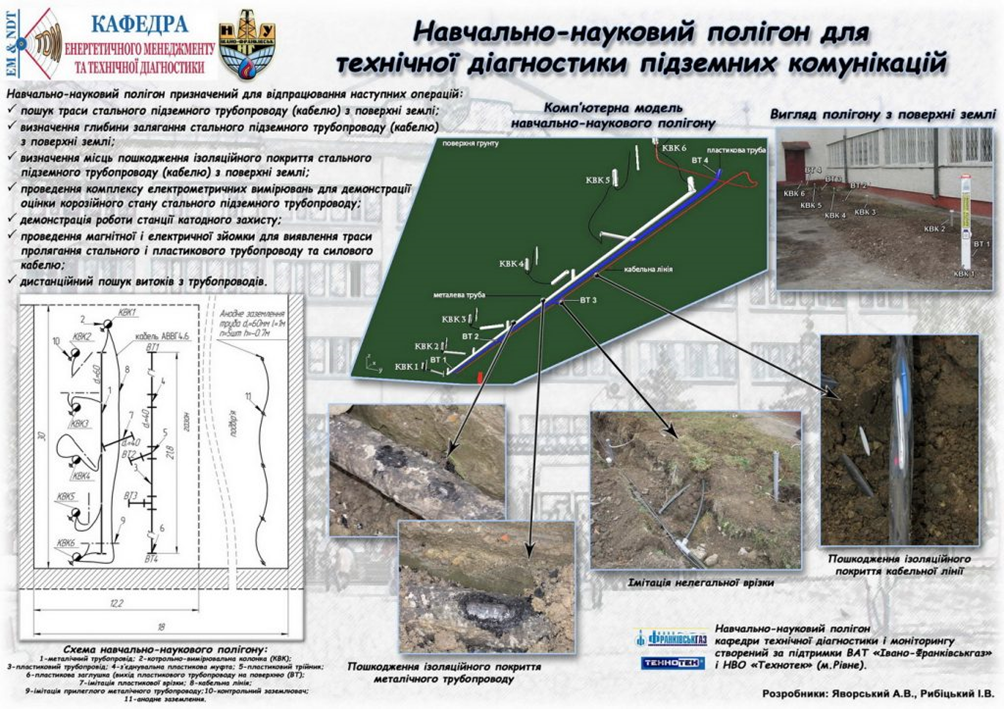
The educational and scientific training site for technical diagnostics of underground utilities at the Department of Energy Management and Technical Diagnostics, IFNTUNG, is a unique practical platform where students master one of the most in-demand and technically complex fields of technical diagnostics. The site is located directly on the department’s premises, and its conditions are as close to real-life as possible — pipelines and cable lines are laid underground, where all search and examination methods are practiced.
Why is Underground Communications Diagnostics Necessary?
Technical diagnostics of underground utilities is a mandatory element in the operation of gas distribution and consumption systems, oil product pipelines, water supply, sewage, and cable lines. The complexity lies in the fact that the object of diagnostics is closed from direct access, making the use of ordinary instrumental methods impossible. For these purposes, specialized high-tech equipment is used.
Equipment of the Training Ground
Electromagnetic pathfinders “Abris TM-7” and “TK-1” are used for tracing the route of underground cables and pipelines using the electromagnetic induction method. The devices allow for determining the location and depth of the utilities without excavation.
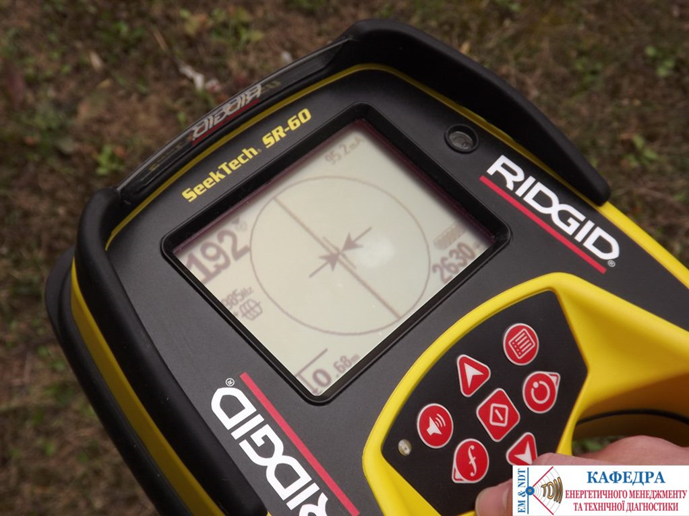
RIDGID SR-60 High-Precision Locator with a search generator – trace-searching diagnostic complex of premium class. The SR-60 device uses a unique circular guidance method for elongated objects and “mapping display” technology: the screen shows not just a simple arrow-pointer, but a visual layout of the communications. The operator only needs to turn on the device and select the type of communication—the system will independently find the route regardless of the user’s orientation to it.
Deep Magnetometer OGF-L designed for locating underground steel pipelines using passive magnetometry — without connecting a signal generator to the pipeline. Used where active connection is impossible or impractical.
Educational Process
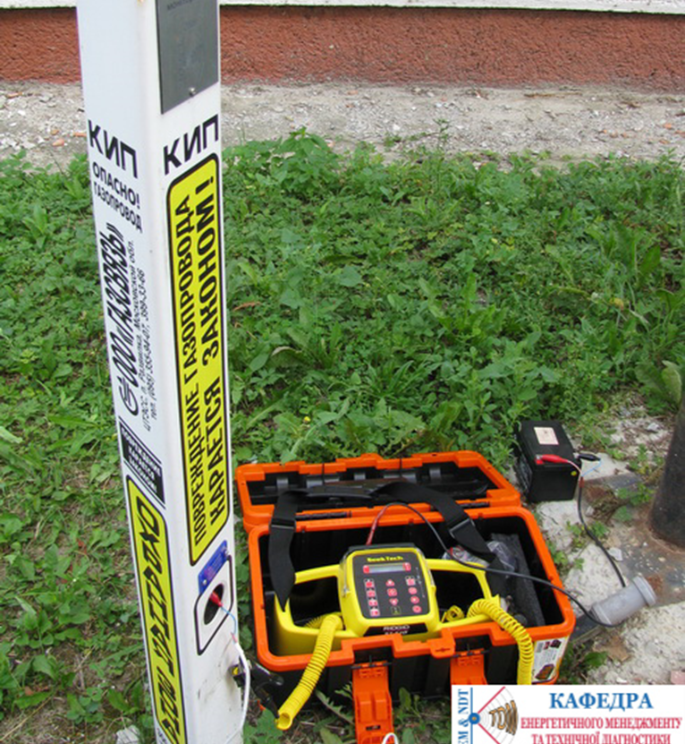
At the training site, students perform practical tasks such as locating and mapping underground utilities, determining the depth of pipelines and cables, and identifying insulation damage. Training takes place on actual underground objects using the same equipment utilized in industrial settings. The acquired competencies are directly needed in the work of gas distribution company engineers, technical diagnostics services, and organizations maintaining underground networks.